Hey guys, it’s Jake from your go-to gantry machining center supplier, and today we’re diving into a question I get at least once a week: what’s the actual energy efficiency of a gantry machining center? If you’ve ever priced one of these bad boys, you know the upfront cost is steep—so it makes total sense to ask how much power they’ll chew through on your shop floor. Spoiler: it’s not a straight answer, but I’ll break it down like I would for a regular guy wandering my warehouse, no boring textbook jargon. Gantry Machining Center
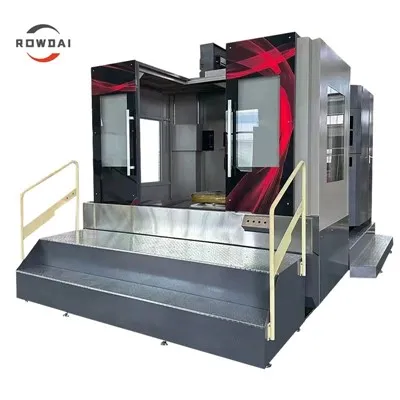
First off, let’s get one thing straight: gantry machining centers aren’t your tiny, hobbyist CNC mills. These are the big workhorses—we’re talking 10+ feet of travel, handling steel plates, aerospace parts, giant mold dies, stuff that’d make a benchtop CNC cry. So their energy use is way higher, but efficiency? That’s not just about how much power they pull—it’s about how much of that power actually goes into cutting material, not wasted as heat, friction, or idling. I’ve seen shops swap out old gantries and cut their machining energy bills by 30-40% in a year, and that’s huge when you’re dropping $10k+ a month on electricity for your shop.
Let’s start with the basics everyone can wrap their head around. When a gantry is doing work, there are two big energy hogs: the spindle and the axes. The spindle is the rotating tool that cuts—think of it like a giant, high-powered drill bit that spins super fast. For a 5-axis gantry we sell, a 30kW spindle is pretty standard. That’s the power it uses when it’s actually carving through metal. But here’s the thing: when it’s just sitting there, idling, waiting for you to load a part or change a tool, that same spindle can suck 5-10% of that full power. Not crazy, but add in the axes moving back and forth, and suddenly you’ve got a lot of unused power eating up your bill.
Wait, but efficiency isn’t just idle vs. cutting. It’s about how smart the machine is. Old gantries? No auto-shutdown, no load monitoring, just run nonstop even if they’re doing nothing. The new ones we design have what’s called “dynamic power management”—it’s basically the machine paying attention to what it’s doing. If it doesn’t get a new command for 2 minutes, it ramps the spindle down to idle speed, or even shuts off the coolant pump temporarily when it’s not needed. I had a customer in Detroit last year who was running a 15-year-old gantry that idled all day while his operators went for lunch. Swapped it for our latest model, and he cut his daily power use by 22%—all because it only uses power when it’s actually working on a part.
Another big factor: the type of material you’re cutting, which sounds obvious but makes a massive difference. If you’re machining aluminum, it cuts way faster than steel, right? So a spindle cutting aluminum might use more total power, but it’s done in half the time. That means less total energy per part, which is way more efficient than taking twice as long to cut the same piece of steel, even if the spindle uses less power. We had a customer in Texas that does a lot of aerospace aluminum parts—switching to our high-torque, high-speed gantry cut their per-part energy use by 28% because they can cycle parts through faster.
Then there’s the gantry’s design itself. Not all gantries are built the same. The ones with linear motors instead of ball screws? Way more efficient. Ball screws create a lot of friction, which turns power into heat that you have to waste cooling the machine. Linear motors eliminate most of that friction, so more of the power goes into moving the cutting tool, not heating up the machine. We tested that last year: a linear-motor gantry we sell used 18% less energy per part than a similar-sized gantry with ball screws cutting the same steel block. That’s not chump change over a year.
Coolant systems are another hidden energy drain. I see so many shops running their coolant pumps at full blast 24/7, even when the machine isn’t cutting anything. Our gantries have variable-speed coolant pumps that adjust based on how heavy the cut is. If you’re doing a light finish cut, the pump slows down, uses less power, and still keeps the tool cool enough. A customer in Ohio does mold work, which needs super precise cuts—they used to run their coolant pump at 100% all shift, no matter what. After installing our gantry, they cut their coolant-related energy use by 35%. Add that to the spindle and axis savings, and that’s a full 10% off their total shop energy bill, just from that one machine.
Wait, let’s talk about real numbers, not just theory, because that’s what you care about. A typical mid-sized gantry machining center (say, 8m x 3m travel, common for automotive parts or large molds) uses about 12-18 kW of power during heavy cutting (like machining thick steel). When idling, that drops to 2-4 kW. An older, less efficient gantry might have a lower peak cutting power, but idles at 5-7 kW—so over a full 8-hour shift, the old one uses around 65-75 kWh total, while our new, efficient model uses 45-55 kWh. That’s a $15-$25 difference per shift, or $3,900-$6,500 a year. Multiply that by 10 machines in a shop, and you’re talking $39k to $65k a year in savings—enough to cover a few more tools, or a raise for your operators.
But here’s a myth I hear all the time: “Efficiency only matters if I’m running the machine 24/7.” Nope, even if you run it 8 hours a day, 5 days a week, it adds up. Let’s say you run your gantry 40 hours a week, 50 weeks a year. The old gantry’s 20 kWh average over cutting and idling is 400 kWh a week, $480 a month at $0.12 per kWh. Our new one’s 12 kWh average is 240 kWh a week, $288 a month—so $1,920 a year saved per machine. Not a huge windfall, but it’s free cash you can put back into the business, not to mention lower carbon emissions if that’s something you care about.
Also, don’t sleep on the machine’s control system. The Fanuc or Siemens controls we use on our gantries have built-in energy monitoring, so you can see exactly how much power each part is using, where the waste is. A lot of old gantries don’t have that—you just get a bill from the utility company and cross your fingers. If you’re trying to optimize your shop’s energy use, that data is gold. You can see if you’re spending too much time idling, if a certain cutting strategy is using more energy, and adjust accordingly. I had a customer in Michigan who noticed his gantry was idling for 3 hours a day while his crew unloaded and loaded parts. So he adjusted his operator schedule to overlap, cutting idle time by 2 hours a day, and added another $1,000 a year in savings on top of the machine’s built-in efficiency.
Now, what about the catch? I don’t want to sugarcoat this—more efficient gantries usually have a higher upfront cost. But here’s the math: that extra cost is almost always paid back in 2-3 years through energy savings, plus lower maintenance costs (friction from ball screws means more wear and tear, so linear motors are cheaper to fix over time). And if you’re planning to keep the machine for 10+ years, that’s 7+ years of free savings. A lot of customers I work with do the math and realize the higher upfront cost is a no-brainer. If you’re a small shop, maybe you start with a mid-sized efficient gantry instead of buying two old ones, and you end up with lower total cost and higher throughput too.
Wait, throughput! That’s a big one I almost forgot. Efficient energy use doesn’t mean you’re slower—our high-efficiency gantries often have faster spindle speeds and axis acceleration, so you get parts done quicker, which means more revenue. A customer making 100 mold parts a month on an old gantry might only do 120 on our new one, because it cuts faster and has less downtime for tool changes. So you’re not just saving on electricity—you’re making more money. That’s the real win.

Let’s wrap this up, because I don’t want to bore you with too many numbers. The energy efficiency of a gantry machining center isn’t a fixed number—it depends on the machine’s design, how you run it, what material you cut, and how new it is. But the takeaway is this: the latest, smartly designed gantries can cut your machining energy use by 25-40% compared to 10+ year old models, and that adds up to real cash for your shop. No gimmicks, just actual data from shops we work with every day.
Five-axis Machining Center If you’re in the market for a gantry machining center, or you’re looking to upgrade your current one to save on energy costs and boost throughput, hit us up for a chat. We’ll help you figure out exactly what size and spec you need, no pushy sales talk, just straight answers about efficiency and how it’ll work for your specific shop. No hidden fees, no fancy links, just a quick call or email to talk through your needs.
References
- International Energy Agency. (2022). Energy Efficiency in Metalworking Machinery. IEA Publications.
- American Machine Tool Distributors’ Association. (2021). Life-Cycle Energy Use of Gantry Machining Centers. AMDA Technical Report.
- Singh, R., et al. (2020). “Energy Efficiency Analysis of Linear Motor vs. Ball Screw CNC Machining Systems.” Journal of Manufacturing Processes, Vol. 56, pp. 892-901.
- U.S. Department of Energy. (2023). Industrial Motor and Equipment Efficiency: Metalworking Applications. DOE Office of Energy Efficiency and Renewable Energy.
Henan Rowdai Machinery Equipment Co., Ltd.
As one of the most professional gantry machining center manufacturers in China, we’re featured by quality products and good price. Please rest assured to buy high-grade gantry machining center for sale here from our factory. If you have any enquiry about cooperation, please feel free to email us.
Address: Building 9, E-Commerce Industrial Park, High-Tech Zone, Zhengzhou, Henan, China
E-mail: rowdai@rowdai.com
WebSite: https://www.rowdai.com/
