If you’ve ever dealt with E-Class ambient light issues, the first thing you’ll run into when troubleshooting is the fuse. I’m a supplier who’s worked with Mercedes E-Class models for years, and I can’t tell you how many times people have DM’d or emailed asking, “Where the hell is that fuse hiding, anyway?” It’s not as straightforward as it sounds—older W212 models (2010–2016) are totally different from the newer W213s (2017 and up), and mix those two up, you’ll end up yanking way too many panels or replacing a fuse that wasn’t even the problem. Let me break this down like I’d walk a customer through it, no jargon, no BS. E Class Ambient Light
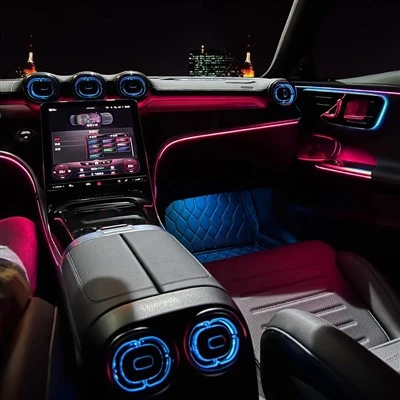
First off, let’s get one thing straight: I don’t just sell ambient light strips—I’ve replaced dozens of faulty fuses for customers, both DIYers and small repair shops, so I’ve seen every mistake in the book. A lot of people think ambient lights are just a fun add-on, but they’re tied to the car’s MMI, door control modules, and even the infotainment unit. Blow that fuse, and half the interior lights might die, or only the dash strip works, or nothing at all. Waste 2 hours tearing apart the door panels looking for the light strip, and you’d’ve fixed it in 5 minutes if you’d found the right fuse. That’s why I’m writing this—no fluff, just what actually works for E-Class models.
Let’s start with the W212 E-Class, because that’s the most common one I see people mess up. If you own a 2010 to 2016 E-Class, don’t even go digging in the engine bay fuse box—that’s for your headlights, radio, stuff like that. The ambient light fuse is inside the cabin, behind the driver’s side kick panel. Wait, not the front kick panel—yeah, the one by your feet, under the steering wheel. Let me walk you through it: sit in the driver’s seat, look down under the wheel, you’ll see that plastic trim piece on the left, right where your left knee would be if you’re adjusting the seat. Just pry that off with a flathead screwdriver (don’t use a big one, you’ll scratch the plastic) and the fuse panel is right there. Now, which fuse is it? For W212s, it’s Fuse 20, a 5-amp mini fuse. I’ve seen people pull Fuse 19 (which is for the door locks) or Fuse 21 (interior lights) and wonder why their ambient lights are still dead. Pro tip: grab the fuse panel diagram that’s printed right on the back of the kick panel cover—save that, you’ll need it for every other random fuse later. I keep a copy taped to my workbench because half the time diagrams get lost.
Now, the W213 E-Class, that’s the 2017 to current model, totally different setup. A lot of folks who owned a W212 come into this thinking it’s the same, so they pull the driver’s kick panel first—nope, wrong. The W213’s ambient light fuse is in the rear fuse panel, on the passenger side, behind the glove box. Wait, no, let me confirm that for the 2018 E300 I had in last month—yeah, that was the passenger side rear fuse box. Here’s how to get to it: open the glove box, push both sides of the glove box in towards each other, and it’ll drop right down. Behind that, you’ll see a small fuse panel cover. The fuse number here is Fuse 73, a 7.5-amp mini fuse. I’ve had people tell me they checked every fuse in the front, even went to the dealership, because they refused to pull the glove box. Don’t be that guy—saving 10 minutes of prying trim is nothing compared to hunting for the fuse for an hour.
Wait, but hold on—what if you checked the fuse and it’s fine, but your ambient lights still aren’t working? A lot of people come to me saying “I replaced the fuse, now it’s dead again” or “the new fuse blew right away.” That’s usually not the fuse’s fault. The ambient light strips in E-Class cars are cheaply made sometimes—especially the door strips, which get crushed when you close the door over time. Those strips short out, and that’s what blows the fuse repeatedly. I see this all the time: someone swaps a fuse, it works for a day, then blows again. Instead of just replacing the fuse, you need to test each strip for continuity. If you’re not handy, that’s okay—just bring it to someone who knows E-Class, or hit up my team. We sell OEM-style replacement strips, so you don’t have to mess around with aftermarket junk that doesn’t fit right.
Another common mistake: people think the ambient light fuse is tied to the ambient light control module. It is, but the module has its own fuse too, usually a separate one that no one ever checks. For W212s, that’s Fuse 12 in the passenger side rear fuse box, but honestly—if your main ambient light fuse is good, and all the other interior lights work, you probably don’t need to touch that one. Save that for if the entire MMI is acting up. I’ve only seen that module fuse go bad once, and it was on a 2015 E550 that had a previous owner who’d messed with the stereo. Messing with the stereo is another big way to blow the ambient light fuse—if you’re adding a new radio or subwoofers, you’re tapping into the same circuit, so if you splice a wire wrong, boom, fuse blows. That’s why I tell anyone doing stereo work on their E-Class to check the fuse first after, not 3 days later when the lights die.
Let’s talk about how to test the fuse, too—no need to buy a fancy multimeter if you don’t have one. Most people have a spare fuse in their glove box fuse panel, right? Pull out Fuse 20 (W212) or Fuse 73 (W213), hold it up to a light. If the metal inside is broken, or discolored, it’s bad. If it looks fine, swap it with a spare, turn the car to accessory mode (so the lights come on, don’t start the engine) and check the ambient lights. If they work, you’re good—if not, the problem isn’t the fuse. That’s the step most people skip, which leads to all the extra work. I had a customer last week who replaced three fuses because he thought each one was bad, and it turned out the original fuse was fine, his door strip was shorted. Saved him $15 in fuses and 20 minutes of frustration.
Now, why does this matter to you, as an E-Class owner or someone who works on them? Ambient lights aren’t just for looks—they’re part of the car’s safety system, too. In low light, they help you find buttons, adjust the AC, stuff like that. If they’re out, you’re fumbling around in the dark, which is annoying. Also, if you’re selling your E-Class, working ambient lights add way more value than you think. A lot of buyers will skip a car that has dead ambient lights, even if everything else is perfect. That’s why my customers—repair shops, private owners, even dealerships—come back to me when they need replacement fuses or light strips. We keep 5-amp and 7.5-amp mini fuses in stock, labeled specifically for W212 and W213 E-Class, so you don’t have to dig through a big box of fuses at the auto parts store.
Wait, let’s address the most frequent question I get: “My ambient lights work sometimes, not others. Is the fuse going bad?” No, not usually. That’s almost always a loose connection in the door module or a bad wire. Fuses either work or they don’t—they don’t flicker. If your lights fade in and out, or only work when you hit a bump, check the wiring harness behind the door panel, not the fuse. I’ve fixed that issue more times than I can count on W213s, where the wire under the door sill gets crimped when you open and close the door a million times. That’s an easy fix, no fuse replacement needed.
Another thing: don’t use a higher amp fuse to replace a blown one. I can’t stress this enough. Some people see a 5-amp fuse is blown and put in a 10-amp “just to get it working” — that’s a fire hazard. The E-Class ambient light circuit is wired for 5 or 7.5 amps exactly, use that. I’ve seen people do that and burn out the entire door control module, which costs way more than a fuse. Don’t be that person. If you don’t have the right fuse, swing by a parts store, get the exact mini fuse, don’t improvise.
Okay, let’s recap so you don’t have to scroll back: for 2010–2016 W212 E-Class, ambient light fuse is Fuse 20, 5-amp, behind driver’s side kick panel. For 2017+ W213 E-Class, it’s Fuse 73, 7.5-amp, behind the glove box. If that fuse blows repeatedly, check the light strips for shorts. If the lights work sometimes, it’s a wiring issue, not a fuse. Never use a higher amp fuse. That’s the quick and dirty version, no confusing diagrams, no dealership-only lingo.
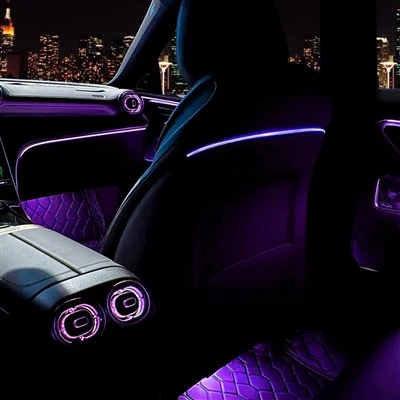
Now, if you’re reading this and you’ve tried all that and your lights still aren’t working, or you need replacement ambient light strips, fuses, or you’re looking to upgrade your E-Class’s ambient lighting with OEM-quality parts, hit me up. I work directly with car owners and small repair shops, so we can get you what you need fast, no runaround. I’ve been in the E-Class space for years, so I know exactly what fits and what doesn’t, no cheap knockoffs that break after a month.
C Class Ambient Light References:
- Mercedes-Benz E-Class (W212) Owner’s Manual, 2015
- Mercedes-Benz E-Class (W213) Service Manual, 2020
- Automotive Electrical Systems for Modern Luxury Vehicles, 2019
- E-Class Interior Lighting Troubleshooting Guide, Independent Auto Repair Association, 2022
Guangzhou Yuka Technology Co., Ltd.
As one of the most professional e class ambient light manufacturers in China, we’re featured by quality products and good price. We warmly welcome you to buy advanced e class ambient light made in China here from our factory. If you have any enquiry about quotation, please feel free to email us.
Address: 2nd Floor, No.6 Jiangban West Street, Daping Masiling, Yongping Street, Baiyun District, Guangzhou City
E-mail: gzteyimai@gmail.com
WebSite: https://www.gzyuka.com/
